

Porsche, a brand synonymous with high-performance sports cars, is steadily accelerating its transition into the electric vehicle (EV) market. The highly anticipated electric version of its popular Cayenne SUV is a significant step in this strategic shift.
This new EV model is slated to arrive in 2026. Importantly, it will be sold alongside the existing gasoline-powered Cayenne for an extended period, catering to a diverse range of consumer preferences. To generate excitement and provide a glimpse into its capabilities, Porsche recently teased the Cayenne EV at a historic hill climb event in England. This strategic public appearance offered the world a clearer look at the vehicle’s design and hinted at its impressive performance.
A Glimpse of the Future: Shelsley Walsh Debut
Porsche chose the iconic Shelsley Walsh hill climb in England as the venue for the first official public appearance of the Cayenne Electric. A camouflaged prototype of the electric SUV tackled the challenging course, offering onlookers and enthusiasts a clearer view of its sleek bodywork. This choice of venue was deliberate. Shelsley Walsh is one of the oldest motorsport venues in the world, having hosted events since 1905. Its rich history and demanding course provided a perfect backdrop to showcase the modern capabilities of Porsche’s latest EV. The event created a buzz, blending heritage with cutting-edge automotive technology.
Near-Production Design Revealed
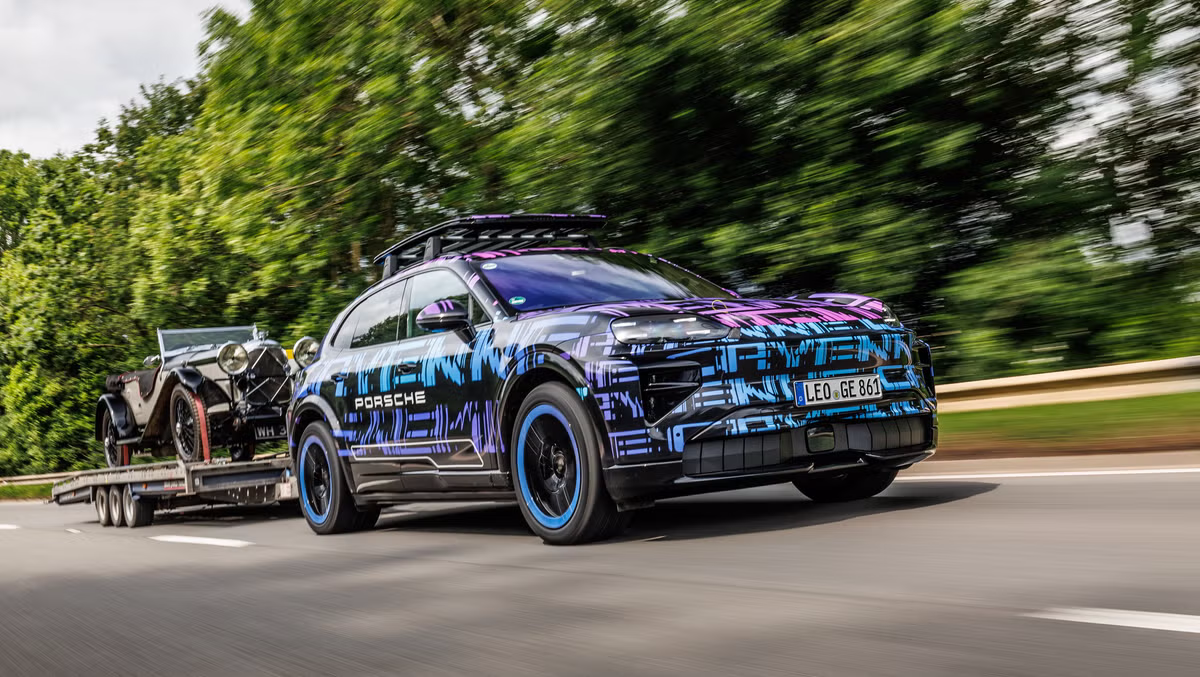
The prototype showcased at Shelsley Walsh was described by Porsche as “near-production.” This suggests that the vehicle’s exterior design is largely finalized. The camouflage wrap was strategically placed. It hinted at key design elements while still maintaining an element of mystery. Even with the camouflage, classic Porsche styling cues were clearly discernible. The front fascia features a large grille in the lower bumper, a characteristic element seen in current Porsche models, adapted for an electric powertrain. High-mounted headlights contribute to the brand’s signature lighting signature.
The body boasts rounded contours, creating a muscular yet elegant silhouette. The rear design concludes with chunky rectangular taillights, providing a modern and distinctive look. A subtle slope to the roofline suggests a blend of SUV practicality with a coupe-like aesthetic, optimizing aerodynamics while maintaining interior space.
Performance Prowess on the Hill
The Cayenne Electric’s appearance at Shelsley Walsh was not merely a design reveal. It was a demonstration of its performance capabilities. Behind the wheel was Gabriela Jílková, a development driver for the Porsche Formula E team. Her expertise in electric performance vehicles was instrumental in showcasing the SUV’s dynamic abilities.
Breaking Records with Electric Power
Porsche announced that Jílková achieved a remarkable feat during her first run up the hill. She beat the previous SUV record time by over four seconds. The new SUV record at Shelsley Walsh, set by the Cayenne EV prototype, is 31.28 seconds, significantly faster than the old record of 35.53 seconds held by a 6-liter Bentley Bentayga W12. This impressive performance underscored the Cayenne Electric’s raw power and handling prowess. It immediately positioned the vehicle as a formidable contender in the high-performance SUV segment, regardless of powertrain type.
Porsche also disclosed a few key details about the Cayenne Electric’s technical specifications. These features contribute significantly to its ability to “scoot up the incline with ease.”
The Power of Porsche Active Ride
One of the standout features highlighted is Porsche Active Ride. This advanced suspension system is a testament to Porsche’s engineering excellence. It is designed to keep the vehicle’s body level at all times, even during aggressive driving maneuvers. Whether accelerating rapidly, cornering sharply, or braking hard, the system actively counteracts body roll and pitch. This results in exceptional stability and a flat, controlled ride. Porsche Active Ride utilizes active two-valve shock absorbers and single-chamber air springs. Each damper is connected to an electrically driven hydraulic pump.
This pump can generate a precise volume flow within the damper, allowing individual wheels to extend or compress rapidly and independently. This ensures that the wheels maintain optimal contact with the road surface, even over uneven terrain. The system’s intelligence is further enhanced by its ability to dynamically adjust spring and damper settings based on vertical, longitudinal, and lateral forces. It also eliminates the need for traditional anti-roll bars, as their function is entirely managed by the active dampers. This innovative technology significantly expands the range between driving dynamics and ride comfort, offering an unprecedented balance.
Explosive Acceleration
Further emphasizing its performance, Porsche revealed an impressive acceleration statistic. The Cayenne Electric, despite being equipped with standard summer tires, covered the first 180 feet (approximately 55 meters) from a standstill in a blistering 1.94 seconds. This acceleration figure is particularly noteworthy. Porsche explicitly stated that such a rapid start is “a result typically reserved for single-seat race cars on slick tires at the event.” This comparison highlights the Cayenne Electric’s phenomenal off-the-line thrust, demonstrating that it possesses sports car-level acceleration despite its SUV form factor.
While Porsche has not yet revealed specific power figures, this early performance data strongly suggests a potent powertrain configuration, potentially exceeding 730 horsepower (739 PS) or even reaching over 1,000 horsepower, as hinted by Richard Hammond. The Cayenne EV is expected to be based on an updated version of the 800V Premium Platform Electric (PPE) architecture, similar to the Macan Electric. This platform is known for its high power output and fast charging capabilities.
Practicality Meets Performance: Towing Capabilities
Beyond its impressive performance on the track, Porsche also showcased the Cayenne Electric’s practical capabilities. As part of a film project tied to the hill climb event, former Top Gear and Grand Tour host Richard Hammond was enlisted to demonstrate the EV’s towing prowess. Hammond used the camouflaged Cayenne Electric to haul a century-old Lagonda, a classic car with considerable weight. This demonstration effectively highlighted the SUV’s robust towing capacity.
Porsche officially claims a towing capacity for the Cayenne Electric of up to 7,716 pounds (approximately 3,500 kg). This figure matches the towing capacity of the current gasoline-powered Cayenne and aligns with other capable EVs like the Rivian R1S. Hammond himself commented on the effortless nature of the towing experience. He noted that even with significant weight behind it, the Cayenne handled the task with remarkable ease. This demonstration underscores that the electric Cayenne will not compromise on the versatility and utility expected from a premium SUV, making it suitable for a wide range of uses, from daily commuting to adventurous hauling.
Market Strategy and Future Appearances
Porsche has confirmed its strategic approach to the Cayenne lineup. The new Cayenne Electric will be sold concurrently with the existing standard Cayenne models, which offer both gasoline-only and hybrid powertrains. This dual-powertrain strategy is set to continue “well into the next decade.” This indicates Porsche’s commitment to offering consumers choices as the automotive industry transitions towards electrification. It also suggests that the internal combustion engine (ICE) and hybrid variants of the Cayenne will remain relevant for many years to come.
The camouflaged Cayenne Electric is scheduled for another public appearance later this week at the Goodwood Festival of Speed. This renowned event, held annually in West Sussex, England, is a celebration of motorsport and automotive culture. It attracts a massive audience and provides an excellent platform for manufacturers to showcase new vehicles. This appearance will offer another opportunity for enthusiasts and the media to see the Cayenne EV in action and gather more insights.
Looking further ahead, Porsche is expected to host the full, official debut of the Cayenne Electric either late this year or early next year. This highly anticipated reveal will likely provide comprehensive details on specifications, pricing, range, and interior features. The launch is rumored to take place at an event on the West Coast, with sales likely commencing in 2026 for the 2027 model year. The Cayenne EV will be produced at Porsche’s manufacturing facility in Bratislava, Slovakia, alongside the combustion version.
The Broader Context of Porsche’s Electrification
The introduction of the Cayenne Electric is a crucial part of Porsche’s broader electrification strategy. The company has already seen significant success with its all-electric Taycan sports sedan and the recently launched Macan Electric SUV. The Cayenne, being one of Porsche’s best-selling models globally, represents a key segment for expanding its EV footprint. The move towards electric SUVs caters to growing consumer demand for sustainable yet high-performance vehicles. This strategic direction aligns with global efforts to reduce carbon emissions and combat climate change.
Porsche’s commitment to electric mobility is not just about environmental responsibility; it’s also about pushing the boundaries of automotive performance and technology. Features like Porsche Active Ride, combined with powerful electric drivetrains, promise to deliver the exhilarating driving experience that Porsche owners expect, but with the added benefits of instant torque, quiet operation, and zero tailpipe emissions.
As the automotive landscape continues to evolve, Porsche aims to remain at the forefront of innovation, blending its rich heritage with a forward-looking vision for the future of mobility. The Cayenne Electric is set to be a cornerstone of this exciting transition.
Enthusiasts and prospective buyers of the BMW M3 should brace for a significant price increase for the 2026 model year. According to a recently leaked internal memo, all variants of Read more
The Ford Mustang is embracing its rich heritage with the introduction of a new FX appearance package. This latest offering for the current S650 generation is a direct homage to Read more
In a significant and consumer-friendly announcement, Volkswagen (VW) has confirmed that it will not implement any price increases on its new vehicles for at least the remainder of May and Read more
French automaker Alpine is boldly charting a new course into the electric era. The brand, an integral part of the Renault Group since 1973, carries a rich motorsport heritage. Alpine Read more
For over a century, the iconic winged 'B' emblem has symbolized Bentley Motors, representing a legacy of luxury, performance, and exquisite craftsmanship. Now, after 106 years of storied history, Read more
This week is marked by significant shifts across the automotive and technology landscapes. Smart, a brand once synonymous with compact urban vehicles, is making an audacious leap into larger electric Read more