

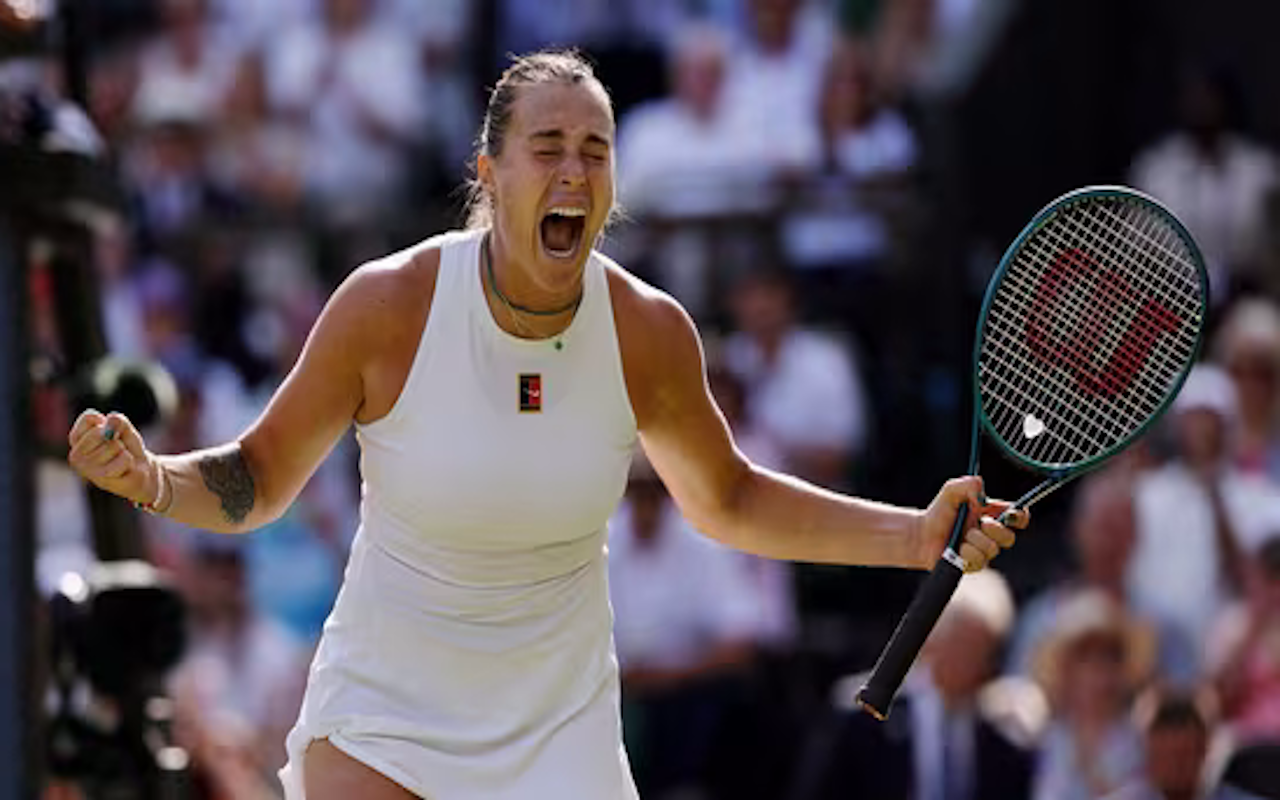
The Wimbledon Centre Court witnessed a gripping quarterfinal clash today, with top-seeded Aryna Sabalenka battling through a stern challenge from the unseeded Laura Siegemund.
In a match that tested both skill and mental fortitude, Sabalenka, the world No. 1 since October of last year, emerged victorious with a final score of 4-6, 6-2, 6-4. Her path to the semifinals was anything but straightforward. She initially dropped the first set, then twice found herself down a break in the decisive third set. However, displaying incredible resolve, she clawed her way back, securing the last three games to seal the hard-fought win. This dramatic comeback lasted 2 hours and 54 minutes, making it the third-longest women’s match of this year’s tournament.
This victory is particularly significant for Sabalenka. Despite her formidable record at other Grand Slams—including two Australian Open titles and one US Open title, along with runner-up finishes at this year’s Australian Open (losing to Madison Keys) and French Open (losing to Coco Gauff)—she has never reached a final at the All England Club. Wimbledon remains the only major tournament where she has yet to play for the championship. This triumph moves her one step closer to achieving that elusive goal.
The Power of Emotional Control
Sabalenka attributed her crucial quarterfinal win to a profound lesson learned from her recent experiences, particularly her performance at the French Open final earlier this year. In that match against Coco Gauff, Sabalenka took the first set but ultimately succumbed, losing after committing a staggering 70 unforced errors. That match served as a stark reminder of how emotions can derail even the most talented players.
“I think there’s a big possibility that I would have lost this match if I didn’t learn that lesson at the French Open,” Sabalenka openly admitted after her match on Tuesday. She explained her internal battle during moments of adversity: “In some moments I just… kept reminding myself, ‘Come on, it’s the quarterfinal of Wimbledon, you cannot give up, you cannot let the emotions just take over you and lose another match.'” This self-talk and conscious effort to manage her emotions proved pivotal, allowing her to stay focused and fight for every point, even when trailing. Her ability to harness her powerful game while reining in her mental fluctuations was a testament to her growth as a player.
A Third Shot at the Wimbledon Semifinals
For the 27-year-old Belarusian, reaching the Wimbledon semifinals is a familiar, yet often frustrating, stage. She previously lost in the semifinals here in both 2021 and 2023. This Thursday, she will get her third chance to break past this barrier. Sabalenka is set to meet the No. 13 seed, Amanda Anisimova. As she prepares for this pivotal match, Sabalenka aims to join an elite group of active women players: only Venus Williams has reached the final at all four major tournaments. Achieving this milestone would further solidify Sabalenka’s status as one of the sport’s all-time greats.
Facing Unorthodox Challenges
Prior to her quarterfinal match on Tuesday, Sabalenka had enjoyed a relatively smooth journey through this year’s grass-court major, not dropping a single set. However, her encounter with Laura Siegemund presented a unique challenge. Siegemund, at 37 years old, was not only the oldest woman in the quarterfinals but also the one with the fewest career titles (just two). She arrived at Wimbledon with a modest career record of 2-5 at the tournament and a 4-9 match record on tour in 2025, making her quarterfinal appearance a remarkable underdog story. Siegemund was even bidding to become the oldest first-time major semifinalist in the Open Era, showcasing her incredible longevity and fighting spirit.
What made Siegemund such a formidable opponent, especially for a power player like Sabalenka, was her unorthodox style. The German possesses an exceptional ability to constantly vary the depth, speed, angles, and spins of her shots. This strategic diversity frustrated Sabalenka throughout the match, particularly in the crucial third set.
“It’s not like it’s an annoying game. It’s a smart game. She’s really making everyone work against her,” Sabalenka acknowledged, recognizing the intelligence behind Siegemund’s tactics. “You know you have to work for every point. It doesn’t matter if you’re a big server, if you’re a big hitter. You have to work. You have to run. And you have to earn the win.” This praise from Sabalenka highlights the effectiveness of Siegemund’s disruptive game, forcing her opponent out of her comfort zone.
The Turning Point: Mental Fortitude Prevails
As the match progressed, Sabalenka’s frustration became visibly apparent. Her unforced errors began to mount, and she would frequently look up at her player’s box with a quizzical expression, raising her hands in exasperation. After one particular missed forehand off a short ball, she even knelt on the grass near the net, a clear sign of her inner turmoil.
The tension reached its peak in the final set. After breaking Sabalenka for the sixth time in the match, Siegemund found herself serving at 40-30, just one point away from taking a commanding 5-3 lead. This moment could have been the end for Sabalenka, reminiscent of her French Open collapse. However, she dug deep, demonstrating her newfound mental resilience. Sabalenka broke right back, seizing the momentum. This pivotal moment sparked her match-ending run, during which she won an impressive 12 of the final 16 points to close out the contest.
Reflecting on the match’s intensity, Sabalenka shared her initial despair. “She pushed me so much, and honestly after the first set I was just looking at my box thinking, ‘Guys, I mean like book the tickets, you know — I think we’re about to leave this beautiful city, country, place,'” she admitted with a laugh, conveying the severity of her internal struggle. Despite the challenge, she expressed immense satisfaction with her victory, adding, “But wow she played an incredible tournament, an incredible match, and I’m just super happy right now with the win.” This honest reflection underscores the mental battle she overcame.
Sabalenka’s Grand Slam Resilience and Head-to-Head Challenges
Sabalenka’s ability to turn matches around after losing the opening set has seen a remarkable transformation in recent years. Since 2022, she boasts an impressive 11-3 record in Grand Slam matches after dropping the first set. This stands in stark contrast to her earlier career, where her record was a worrying 2-13 in such scenarios. This significant improvement is a clear indicator of her enhanced mental toughness and strategic adjustments.
Furthermore, her performance in major quarterfinals has been exceptionally strong. Sabalenka has an outstanding 12-1 record in Grand Slam quarterfinals, with her only loss at this stage coming against Mirra Andreeva at last year’s French Open. This winning percentage is the second-best by any woman in the Open Era, trailing only the legendary Chris Evert. This statistic highlights her consistent ability to perform under pressure in the critical late stages of major tournaments.
Looking ahead to Thursday’s semifinal, this will mark the second consecutive meeting at a major tournament for Sabalenka and Anisimova. Their previous encounter was at the French Open Round of 16 earlier this year, where Sabalenka secured a straight-sets victory. However, despite that recent win, Anisimova holds a slight 5-3 edge in their overall head-to-head meetings. Notably, only two other active players have more wins over Sabalenka at the tour level: Iga Swiatek (8 wins) and Coco Gauff (6 wins).
Crucially, Sabalenka and Anisimova have never played each other on grass. This adds an interesting dimension to their upcoming semifinal clash. Sabalenka recognizes Anisimova’s potential on this surface. “I definitely think this surface suits her game really well,” Sabalenka commented, showing respect for her opponent’s abilities. “That’s why she’s playing so well so far.”
Anisimova’s powerful groundstrokes and flat hitting could be particularly effective on the faster grass courts. This sets the stage for a compelling and unpredictable semifinal battle, as Sabalenka aims to finally reach her first Wimbledon final. The tennis world eagerly awaits to see if she can conquer her last Grand Slam hurdle.

The opening round of the U.S. Open at Oakmont, a notoriously challenging course, delivered a truly extraordinary moment on Thursday. Patrick Reed, the 2018 Masters champion, etched his name into Read more

Ryan Yarbrough's night on the mound for the New York Yankees started with an unexpected challenge. His sixth pitch of the game resulted in a leadoff home run. However, what Read more

The 2025 MLB All-Star Game is rapidly approaching, set to take place at Truist Park in Atlanta on July 15. With the official ballot for the Midsummer Classic unveiled on Read more

The highly anticipated FIFA Club World Cup quarter-final clash between European giants Bayern Munich and Paris Saint-Germain on Saturday took a dramatic and unfortunate turn. In a moment that Read more

The Indiana Pacers have officially secured their spot in the 2025 NBA Finals! On Saturday, May 31, 2025, the Pacers triumphed over the New York Knicks in Game 6 of Read more
Was dubbed "golf's longest day," as players across North America battled for coveted spots in the 2025 U.S. Open at Oakmont Country Club, scheduled for June 12-15. With 47 Read more