

Astronomy enthusiasts and casual skygazers alike have likely seen headlines buzzing about a potentially visible ‘smiley face’ alignment set to grace the morning sky this Friday, April 25th. This much-discussed celestial event involves the close proximity of the Moon, Venus, and Saturn.
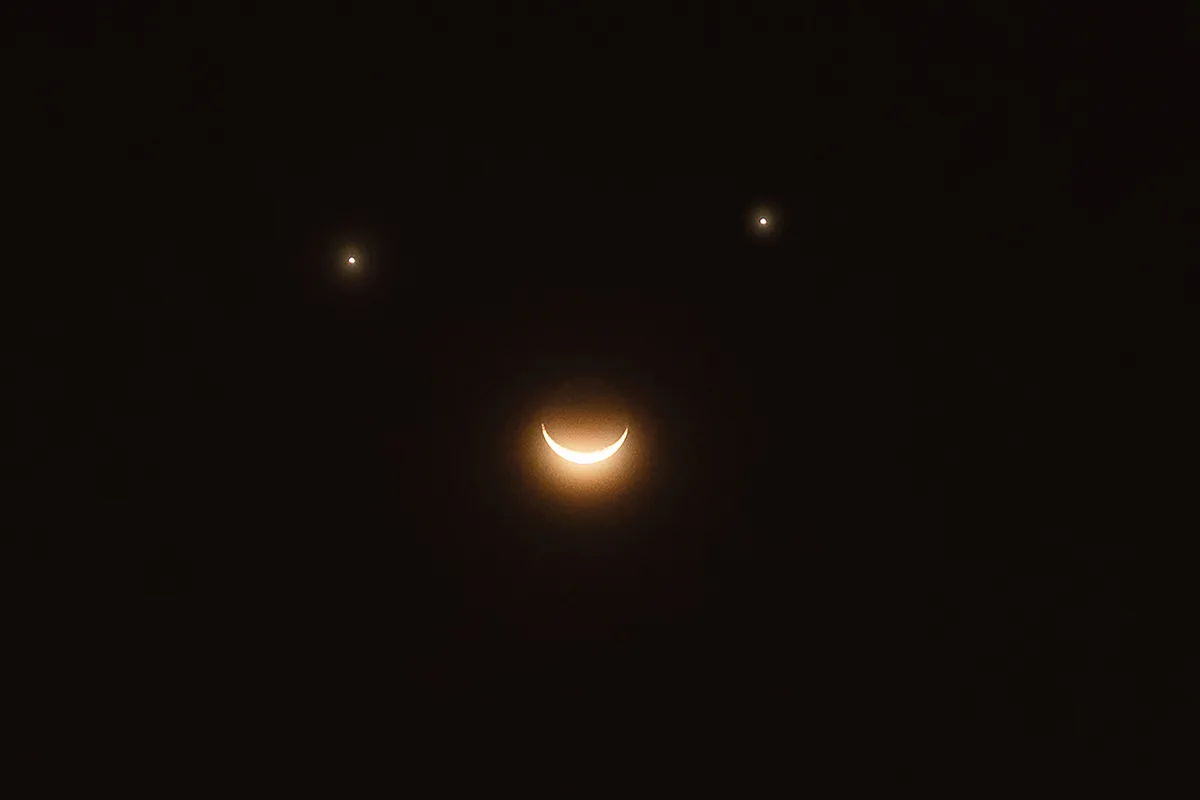
While the online buzz highlights the ‘smiley face’ aspect, understanding exactly what you’ll observe requires separating the hype from the astronomical reality. Let’s delve into what this unique alignment entails and how you might be able to catch a glimpse.
What Creates the Celestial ‘Smiley Face’?
Simply put, the ‘smiley face’ visual is formed by a close gathering of three distinct celestial bodies: the thin crescent Moon, the planet Venus, and the planet Saturn, appearing near each other in the predawn sky.
However, it’s crucial to note the ‘face’ won’t appear upright. The configuration will actually look like a smiley face rotated 90 degrees clockwise. In this arrangement, the slender crescent Moon makes up the ‘smile’, the bright planet Venus acts as the right ‘eye’, and the significantly dimmer planet Saturn represents the left ‘eye’ of this cosmic pattern.
Astronomically, when a planet appears near the Moon, it’s termed a conjunction. When two or more planets are situated closely to the Moon in the sky, as in this specific instance, the phenomenon is sometimes referred to as a massing.
Will the ‘Face’ Be Clearly Visible?
With various reports circulating online about the April 25th alignment, it’s important to have realistic expectations regarding visibility. Both the bright planet Venus and the slender crescent Moon should be relatively easy to spot, provided observing conditions are favorable.
Venus is currently a very bright object in the morning sky, typically rising in the east around 05:00 BST (British Summer Time) and remaining visible until shortly before sunrise (which occurs just before 06:00 BST). As Friday the 25th approaches, the Moon journeys eastward across the sky, appearing closer to Venus each morning. By April 25th, the waning crescent Moon (having passed Full Moon on April 13th and heading towards New Moon on April 27th) will rise with Venus around 05:00 BST, positioned below the brighter planet. Assuming a clear view of the eastern horizon and clear weather, sighting Venus and the Moon should be straightforward.
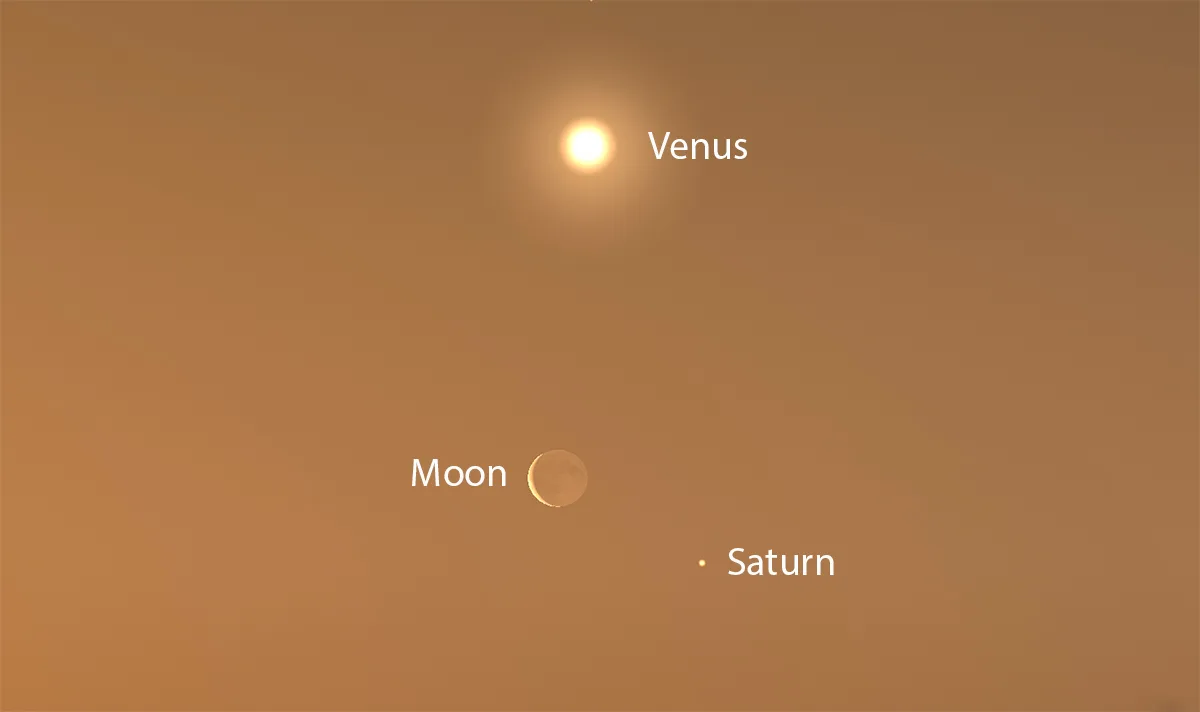
The main factor that might hinder observers from seeing the complete ‘smiley face’ configuration is the visibility of Saturn. Saturn is considerably fainter than Venus and rises last among the three celestial bodies, appearing lower in the sky relative to Venus and the Moon. Its dimness, combined with its low position and the increasing brightness of the approaching sunrise, makes spotting Saturn quite challenging without optical aid or exceptional viewing conditions.
Tips for Viewing (and Staying Safe)
For those determined to witness this unique Moon-planet alignment, maximize your chances by finding a location with an unobstructed view of the eastern horizon. Ensure you check the weather forecast for clear skies and plan to observe during the narrow window just before sunrise.
However, safety is paramount. Because Venus, Saturn, and the Moon will be positioned in the same general area where the Sun is about to rise, and shortly before it clears the horizon, extreme caution is necessary. Never look directly at the rising Sun with your naked eyes, as this can cause severe and permanent eye damage. Furthermore, absolutely avoid using binoculars or telescopes to view Venus, the Moon, or Saturn when they are close to the Sun’s position, as magnifying the Sun’s rays is highly dangerous.
Set your alarm, find a good viewing spot facing east, and enjoy the sight of the Moon and Venus drawing close in the predawn sky – and if conditions are perfect, you might just glimpse Saturn completing the sideways ‘smiley face’.
The Sun recently displayed its immense power with the emission of a significant solar flare. Powerful X2.7 Solar Flare Erupts from Sun This strong burst of Read more
Tech industry giant Intel, headquartered in California, is reportedly preparing for a substantial reduction in its workforce. According to recent reports citing internal information and sources, the company plans to Read more
The thunderous roar, the brilliant ascent against the twilight sky – a spacex rocket launch is more than just an engineering feat; it's a powerful symbol of human ambition and Read more

The vast and mysterious depths of the Atlantic Ocean continue to reveal incredible marine life, and recently, researchers have been tracking a truly remarkable specimen. The largest great white Read more

The way we interact with the internet is undergoing a profound transformation. For decades, the traditional search engine, exemplified by Google, has served as our primary gateway to online information. Read more
Eligible Apple users in the United States who may have been impacted by alleged past issues concerning Siri privacy now have the opportunity to submit claims for a share of Read more