

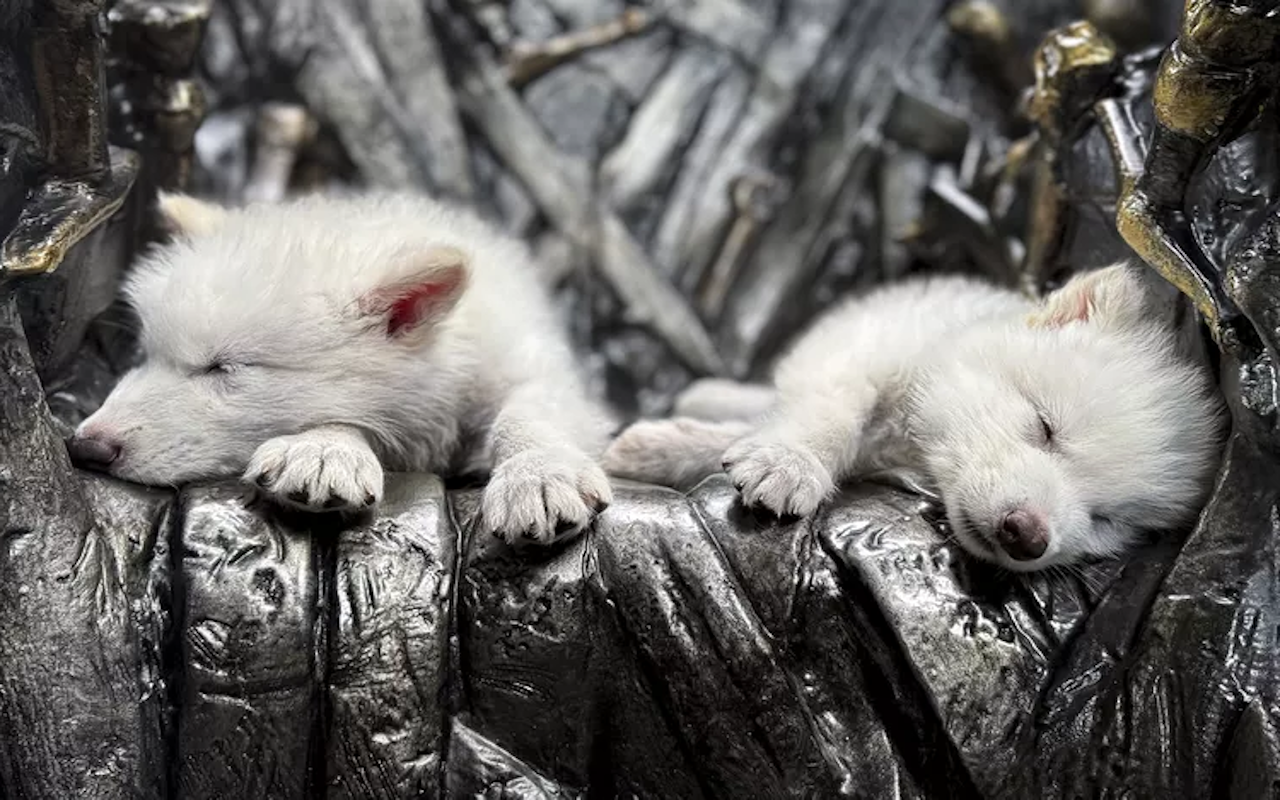
The audacious endeavor of bringing extinct species back to life has taken a significant leap forward. Colossal Biosciences, a pioneering company at the forefront of de-extinction efforts, recently shared a thrilling progress update on its groundbreaking dire wolf project.
These magnificent creatures, once apex predators of ancient North America, have been successfully “de-extincted.” The world’s first new dire wolves in millennia—named Romulus, Remus, and Khaleesi—are not only thriving but also exhibiting astonishing growth rates, showcasing the remarkable success of this ambitious scientific undertaking. Their rapid development offers a tangible glimpse into a future where lost species might walk the Earth once more.
Astounding Growth: Pups Outgrow Modern Wolves
Colossal Biosciences’ six-month growth report, published on June 20, provides a detailed account of the impressive development of these nascent dire wolves. The report focuses on the two male pups, Romulus and Remus, and their slightly younger female counterpart, Khaleesi. The data presented is nothing short of remarkable, highlighting the distinct genetic traits that differentiate these de-extinct animals from their modern relatives.
Romulus and Remus: Doubling in Size and Beyond
The two male dire wolf pups, Romulus and Remus, have demonstrated exceptional growth in a remarkably short period. At just a little over six months old, both pups now weigh more than 90 pounds. This weight is a significant indicator of their rapid development. When Colossal Biosciences first introduced these animals to the public in April, the pups were well over double the size of typical wolf pups. Their current size continues to outpace standard expectations for their age.
Matt James, Colossal’s Chief Animal Officer, expressed immense satisfaction with the project’s progression. In an update video, he confirmed that the dire wolf pups are hitting all their developmental milestones precisely as planned. “Today, Romulus and Remus, at a little over six months old, weigh a little more than 90 pounds, which is about 20% larger than a standard gray wolf,” James proudly shared. This size differential is crucial. It suggests that the specific genetic modifications and selective breeding employed by Colossal are successfully activating the ancient dire wolf genes responsible for their larger stature.
“So we can really tell that the dire wolf genes are kicking in and we’re getting these nice large wolves that are much more representative of what we see in the ancient specimens,” James added. This robust growth signifies that the de-extinction methodology is effectively translating genetic blueprints into physical characteristics consistent with historical dire wolf populations.
Khaleesi: A Younger, Yet Still Larger, Sister
While slightly younger than her brothers, the female pup Khaleesi is also exhibiting impressive growth. James noted that Khaleesi is approximately three months old and, as expected, more petite than Romulus and Remus. However, her current weight of around 35 pounds places her firmly in the realm of larger-than-average wolf pups for her age. She is roughly 15% to 20% larger than a standard gray wolf pup at three months.
This sustained larger growth across all pups reinforces the success of the de-extinction process in imbuing them with dire wolf characteristics. Khaleesi is currently being kept separate from her brothers for safety reasons. However, the team anticipates that she will soon be large enough to safely integrate into their pack, fostering a complete social unit.
Daily Care and Emerging Pack Dynamics
The daily lives of these nascent dire wolves are meticulously managed by a dedicated care team. Their routine focuses on nurturing their physical health and observing their emerging social behaviors. These observations are critical for understanding how these de-extinct animals develop and interact within a pack structure.
Veterinary Check-ups and Scientific Insights
Romulus and Remus are preparing for their first annual veterinary appointments. These medical check-ins are not merely routine; they are incredibly exciting and necessary for the Colossal team’s scientific objectives. These appointments provide an invaluable opportunity to gather detailed biological data. Veterinarians will draw blood from the dire wolves, allowing researchers to analyze their genetic markers, health indicators, and metabolic profiles. Additionally, comprehensive CT imaging will be performed.
This advanced imaging will provide the team with an in-depth, three-dimensional picture of the animals’ skeletal and muscular systems. Such detailed anatomical information is crucial. It allows scientists to compare the physical development of these de-extinct wolves with both modern gray wolves and the fossil records of ancient dire wolves. This comparative analysis helps validate the success of the de-extinction process and offers insights into the unique adaptations of dire wolves.
Leadership and Social Hierarchy
Observing the emerging pack dynamics among the pups is a fascinating aspect of their daily care. Paige McNickle, who manages the dire wolves’ daily care team, has already noted distinct personality traits and an initial hierarchy forming between the two male pups. Remus, despite being slightly smaller than Romulus, has begun to assert himself as the leader of the pack. Conversely, Romulus is effectively “stepping down and being more subordinate.”
McNickle provided insights into Remus’s leadership style. “Remus really likes to watch things, and he figures stuff out,” she explained. This suggests a more cunning and observational leadership. “He’s also a little bit smaller, so sometimes that’s interesting to think that the smaller of the two would be the more dominant. But he’s crafty and he’s always watching.” This highlights that dominance in a pack is not solely determined by physical size but also by intelligence and strategic thinking.
Romulus, whom McNickle described as “the beta,” exhibits traits consistent with a subordinate role. He tends to go out first when the dire wolves eat and play. McNickle referred to this behavior as “very much a beta trait,” explaining that it allows pack leaders to “lead from the back,” assessing potential dangers before committing.
However, McNickle emphasized that these early pack dynamics are not necessarily set in stone. “It may not stay that way as they continue to grow up,” she added. “That may change. It could change when we add Khaleesi into the mix. As they’re still young, that pack dynamic isn’t set. It’s still very fluid.” The introduction of Khaleesi is expected to further influence and potentially reshape the existing social structure, as she finds her place within the growing pack.
Diet and Future Instinctual Development
The diet of the dire wolf pups is carefully managed to support their rapid growth and provide optimal nutrition. McNickle reported that the animals are currently eating adult-sized portions. Their diet consists of a balanced mix of high-quality dog kibble, ground meat, and organ meats. This ensures they receive all the necessary proteins, fats, and micronutrients for healthy development.
As the animals mature, their diet will evolve. McNickle confirmed that as the pups get older, they will be given whole prey items. This is a crucial step in nurturing “their abilities and instincts” for eating in the wild. Providing whole prey encourages natural behaviors like tearing, gnawing, and consuming bones and fur, which are vital for developing strong jaws, teeth, and digestive systems, as well as refining their predatory instincts. This progressive feeding strategy aims to prepare them for a more natural existence, aligning with their de-extincted genetic programming.
Future Integration and Conservation Implications
The integration of Khaleesi with Romulus and Remus is a carefully planned phase of the project. For now, Khaleesi is being kept separate to ensure her safety, given her younger age and smaller size compared to her rapidly growing brothers. However, the animals are not entirely isolated. They can see and smell each other through a secure gate. This allows them to gradually become accustomed to each other’s presence, providing the care team with valuable insights into their collective temperament and social compatibility before a full introduction.
Ensuring Social Compatibility
James underscored the importance of this cautious approach to introduction. “Before we make the introduction of bringing Khaleesi into the group with the boys, we’re going to be looking for really strong indicators that they are socially compatible,” he explained. This meticulous observation is vital for a smooth and safe integration. The team will assess their body language, vocalizations, and reactions to each other to ensure a harmonious pack formation. “We’re really excited about that,” James concluded, highlighting the anticipation surrounding this significant step in their development.
The Broader Vision of De-Extinction
The successful arrival of the dire wolves was first announced by Colossal Biosciences in a statement on Monday, April 7. This came shortly after their groundbreaking announcement of the de-extinction of the woolly mouse, another major milestone for the company. The dire wolf project exemplifies the cutting-edge scientific work being undertaken at Colossal.
Ben Lamm, CEO and co-founder of Colossal, emphasized the profound implications of their work at the time of the dire wolf announcement. “Our team took DNA from a 13,000-year-old tooth and a 72,000-year-old skull and made healthy dire wolf puppies,” Lamm stated. This achievement is truly remarkable, bridging vast stretches of time through advanced genetic engineering. He then drew a parallel to Arthur C. Clarke’s famous quote: “‘Any sufficiently advanced technology is indistinguishable from magic.’ Today, our team gets to unveil some of the magic they are working on and its broader impact on conservation.”
Lamm’s reference to magic highlights the awe-inspiring nature of de-extinction. It positions Colossal Biosciences’ efforts not just as a scientific endeavor but as a transformative force with profound conservation implications. The broader goal of such projects extends beyond merely bringing back a single species. It aims to revitalize ecosystems that have suffered from the loss of key apex predators or keystone species. The return of dire wolves, for example, could help restore ecological balance in certain habitats, controlling prey populations and enhancing biodiversity.
While still in its early stages, the rapid growth and healthy development of Romulus, Remus, and Khaleesi offer tangible hope that the dreams of de-extinction are steadily becoming a scientific reality. This ambitious work promises to reshape our understanding of conservation and humanity’s role in repairing past ecological damage.

Imagine your office view changing from a cubicle wall to a sandy beach in Thailand, a bustling cafe in Lisbon, or a mountain retreat in Colombia. This dream is the Read more

This week, from May 24 to May 30, 2025, offers various opportunities for meteor observation. The Moon will enter its new phase on Tuesday, May 27th. This means it will Read more

New rumors circulating about the upcoming iPhone 17 Air are dampening some of the display excitement previously anticipated for Apple's next smartphone generation. While information regarding the iPhone 17 Read more

Last week, numerous mobile phone users in the UK experienced significant disruption to their services. A major outage affected customers of Three UK, one of the nation's prominent mobile network Read more

Internet and cable services provided by Xfinity and Comcast Business to customers in the Houston area have been fully restored. The widespread disruption was identified by the company as being Read more
In the fiercely competitive smartphone market, battery life remains a paramount concern for users. Apple, a company known for its meticulous design and efficiency, has been steadily improving the endurance Read more