

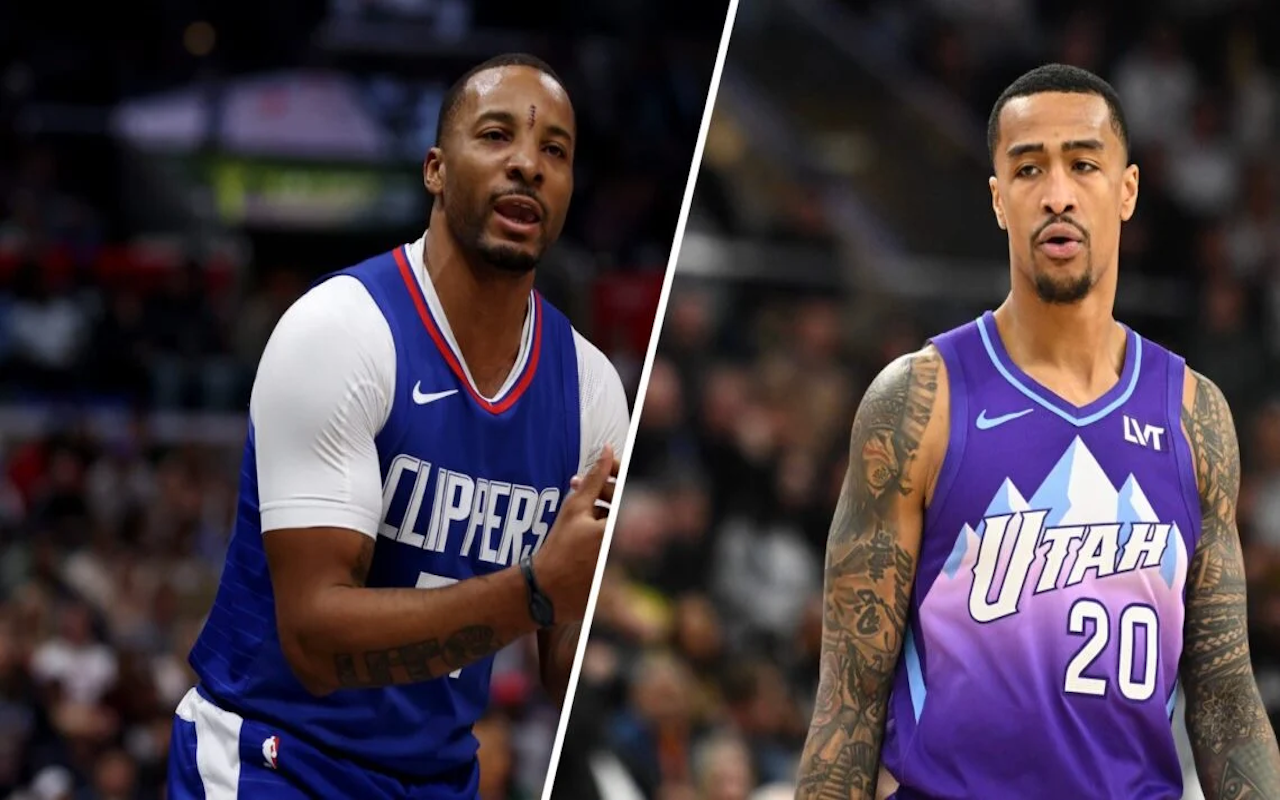
The National Basketball Association (NBA) offseason continues to deliver high-impact moves, reshaping team rosters and strategic directions. On Monday, July 7, 2025, a significant three-team trade was finalized, involving the Los Angeles Clippers, Utah Jazz, and Miami Heat.
This complex transaction saw key players change uniforms, with Norman Powell heading to Miami, John Collins joining the Clippers, and Kevin Love, Kyle Anderson, along with a 2027 second-round pick from the Clippers, moving to Utah. This deal, reported by sources to ESPN, highlights each franchise’s distinct goals as they prepare for the upcoming season and beyond.
Miami Heat: Adding Offensive Firepower with Norman Powell
The Miami Heat, coming off a tumultuous season that included the departure of Jimmy Butler to the Golden State Warriors and an early first-round sweep by the Cleveland Cavaliers, were in dire need of a significant offensive boost. Their struggles with consistent scoring and shooting were evident throughout the previous campaign. The acquisition of Norman Powell, a 32-year-old shooting guard, directly addresses these critical needs.
Powell is fresh off his best professional season, where he averaged a career-high 21.8 points per game. This impressive scoring output, achieved while starting all 60 games he played for the first time in his career, cemented his status as an All-Star candidate. His offensive prowess is further underscored by his exceptional three-point shooting, where he converted an impressive 42% of his attempts last season. This sharpshooting ability will immediately provide much-needed spacing and scoring punch for the Heat.
Beyond his statistics, Powell is widely regarded as one of the NBA’s hardest-working players. His commitment to his craft and his tenacious approach to the game align seamlessly with Miami’s renowned “Heat Culture,” known for its emphasis on effort, grit, and discipline. The 6-foot-4 guard is expected to fit into Miami’s system without issue, providing immediate impact as a strong two-way player.
Financially, Powell is entering the final year of his current contract, which is set at $20.4 million for the upcoming season. He is also eligible for an extension. While the Heat will absorb his salary, potentially pushing them slightly over the luxury tax threshold, his proven ability to score and shoot from long range makes him a valuable addition. Miami’s decision to bring in Powell indicates a clear intent to rebound strongly and enhance their offensive capabilities, aiming for a more successful playoff run. This trade suggests that the Heat are willing to invest in established talent to immediately improve their roster’s competitive outlook.
Los Angeles Clippers: Bolstering the Frontcourt with John Collins
The Los Angeles Clippers have long sought to add an athletic big man who can contribute on both ends of the floor. The acquisition of John Collins, a 27-year-old power forward, directly addresses this need. The Clippers have coveted players with Collins’s specific skill set in the past, valuing his athleticism, rebounding, and ability to play above the rim.
Collins, standing at 6-foot-9, averaged 19 points and 8.2 rebounds in 40 games for the Utah Jazz last season. His offensive game is characterized by his efficient finishing around the basket, his strong lob threat, and an improving ability to stretch the floor with his shooting. On the defensive end, his athleticism allows him to guard multiple positions and contribute to rim protection. This combination of skills makes him an ideal fit for the Clippers’ frontcourt, which often relies on versatile players alongside stars like Kawhi Leonard and James Harden.
Like Powell, Collins is also entering the final year of his contract, set to earn $26.5 million this coming season. Sources indicate that both Powell and Collins were unlikely to sign extensions with their respective previous teams, making them prime candidates for trades designed to optimize financial flexibility. For the Clippers, bringing in Collins means adding a dynamic forward who can complement their existing stars and address a persistent need for frontcourt athleticism and depth. His ability to run the floor, finish strong, and potentially improve his three-point shooting will be valuable in the Clippers’ offensive schemes.
This move comes after the Clippers recently agreed to a new two-year, $81.5 million contract with James Harden. The second year of Harden’s deal includes a player option and is partially guaranteed, providing some flexibility. Los Angeles also signed veteran center Brook Lopez to a two-year, $18 million deal with a team option for the second year. These moves collectively suggest that the Clippers are looking to solidify their roster around their star duo while maintaining an eye on future financial maneuvers. The team can still utilize its $5.3 million non-tax midlevel exception to potentially add another shooting guard or playmaking point guard, further bolstering their roster depth.
Utah Jazz: Strategic Rebuild and Future Flexibility
For the Utah Jazz, this three-team trade represents a calculated step in their ongoing rebuilding efforts. By sending out John Collins, the Jazz have not only acquired additional assets but have also created significant future financial flexibility. The return for Collins includes veteran players Kevin Love and Kyle Anderson, along with a valuable 2027 Clippers second-round pick.
While Love and Anderson are established veterans, their roles in Utah are likely to be different from their previous teams. The 36-year-old Love, a five-time All-Star, averaged 5.3 points and 4.1 rebounds in 23 games for the Heat last season. Anderson, 31, acquired by Miami in a trade with the Golden State Warriors involving Jimmy Butler last season, averaged 6.7 points in 25 games after the trade. For the Jazz, these players may serve as veteran mentors for a young roster, or potentially as assets for future trades or buyouts, allowing the team to continue its focus on youth development and draft capital.
A key benefit for the Jazz in this transaction is the creation of a substantial $26.6 million trade exception. A trade exception is a salary cap mechanism that allows a team to acquire players in subsequent trades without sending out matching salary, provided they do so within one year. This large exception grants the Jazz immense flexibility to take on salary in future deals, potentially acquiring more draft picks or promising young players from teams looking to shed salary.
This trade is part of a broader offseason strategy for the Jazz. They have already been active, having traded Collin Sexton and a second-round pick to Charlotte for Jusuf Nurkic earlier in the offseason. Additionally, they completed a contract buyout of guard Jordan Clarkson, further clearing their roster and salary sheet. These moves collectively indicate that Utah is prioritizing future draft capital, developing its young core, and maintaining financial maneuverability for the coming seasons. The Jazz are firmly in a rebuilding phase, and each trade, including this latest one, is designed to position them for long-term success through accumulating assets and fostering young talent.

Boston Red Sox fans are eagerly anticipating the major league debut of top prospect Roman Anthony. His recent performance on Saturday night for the Triple-A Worcester Red Sox (WooSox) provided Read more

The 2025 MLB All-Star Game is rapidly approaching, set to take place at Truist Park in Atlanta on July 15. With the official ballot for the Midsummer Classic unveiled on Read more

Georgia Amoore, a highly anticipated rookie for the Washington Mystics and former University of Kentucky All-American, is facing the likelihood of missing her entire first season in the Women's National Read more

Game 3 of the 2025 NBA Finals in Indianapolis was not just a pivotal matchup between the Indiana Pacers and the Oklahoma City Thunder; it was a vibrant celebration of Read more

The highly anticipated FIFA Club World Cup quarter-final clash between European giants Bayern Munich and Paris Saint-Germain on Saturday took a dramatic and unfortunate turn. In a moment that Read more

A golf cart accident that reportedly involved former NFL star John Elway on Saturday, April 26, has left his friend and former agent, Jeff Sperbeck, with a severe head injury. Read more